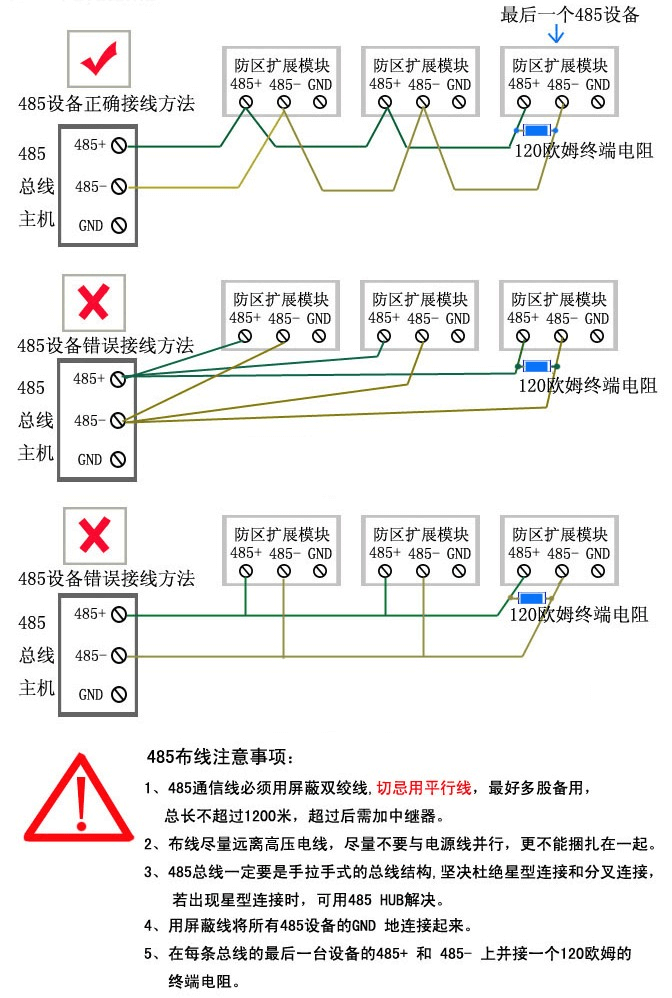
1. The system communicates over an RS485 bus. Use 2-core shielded twisted-pair cable.
Requirements: copper conductors of 0.5-0.75 mm², impedance 38-88 Ω/km, capacitance 30-50 nF/km, lay length 20 mm, 2-core shielded twisted pair. (For runs of less than 500 m the specification may be relaxed somewhat, but the cable must still be twisted pair.)
2. A bus segment (two or more devices with a physical connection between them) may carry at most 128 devices, and without a repeater the bus length must not exceed 1200 m.
3. The bus should not branch. Where a branch is unavoidable, all of the following must be observed:
● Branch length must not exceed 10 m
● Total bus length must not exceed 800 m
● No more than 50 devices may be connected to the branch
● Keep all communication cabling as far as possible from sources of interference. Signal cables should run in a dedicated low-voltage duct and must not run parallel to mains power (such as a 220 V domestic supply) or RF cabling (such as CATV or high-level audio). Where a parallel run is unavoidable, keep a separation of more than 0.5 m
● Every joint must be soldered or clamped in a screw terminal, and then protected against water and damp - for example, solder the joint and wrap it tightly in waterproof tape, or seal it with epoxy resin
4. Common signal ground
● Every device on the same segment must share a common signal ground, to avoid common-mode interference
● With a centralised supply, tie the DC negative of every power source on the segment (including supplies built into the communication devices) directly together to form the common signal ground. The signal ground is then the DC supply ground
● With separate local supplies, tie the ground (black wire) pins of all bus devices on the segment together to form the common signal ground
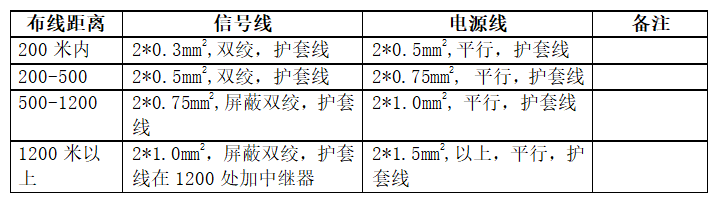
5. Recommended bus cable types
6. Field wiring examples