
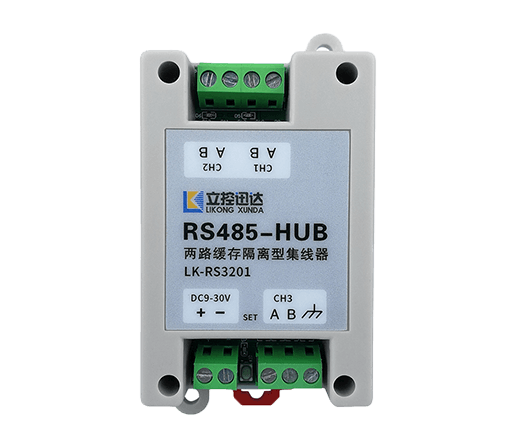
Input voltage: DC 9-30 V
Buffer: 512 bytes
Transmission distance: 1200 m
Masters supported: 2
Isolation: opto-isolation between master and slave
Baud rate: 1200-115200, configurable
Port protection: ESD and lightning surge protection
Data format: configurable data bits and parity
The LK-RS3201IS 2-master buffered isolated RS485 hub connects two RS485 master devices to one or more RS485 slave devices. It removes the bus conflicts that occur when two masters talk to the slaves at the same time: data requested by master 1 is returned only to master 1, never to master 2, and likewise data requested by master 2 is returned only to master 2.
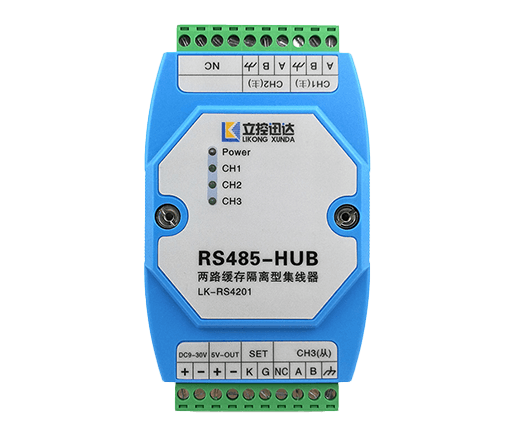
Input voltage: DC 9-30 V
Buffer: 1024 bytes
Transmission distance: 1200 m
Masters supported: 2
Isolation: opto-isolation between master and slave
Data format: configurable data bits and parity
Extra features: configurable master port priority
Port protection: ESD and lightning surge protection
Baud rate: 1200-115200 (set independently for every port)
The LK-RS4201 2-master fully isolated buffered RS485 hub connects two RS485 masters to one or more RS485 slaves. It queues the masters automatically and forwards their data without user intervention.
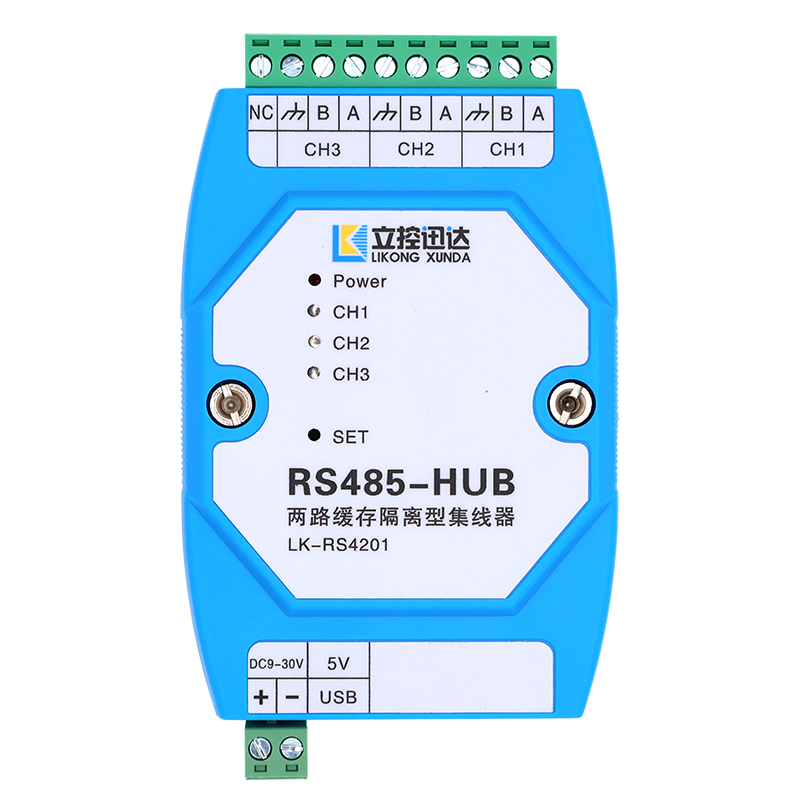
Input voltage: DC 9-30 V
Power consumption: <3 W
RS485 channels: 3
Nodes supported: 250
Operating modes: transparent queuing / Modbus queuing / Modbus buffering / one master to many slaves
Protocol: transparent transmission / Modbus
Baud rate: 1200-115200
ESD protection: 15 kV
Surge protection: 5 kA
Operating temperature: -40 °C to 85 °C
The LK-RS4201P connects two masters to multiple slaves, offering several operating modes and a built-in web configuration page. It supports address mapping, address filtering and data buffering, with opto-isolated master and slave ports plus surge and ESD protection.
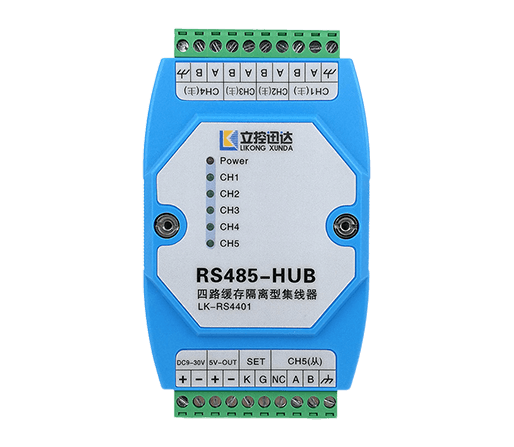
Input voltage: DC 9-30 V
Buffer: 1024 bytes
Transmission distance: 1200 m
Masters supported: 4
Isolation: opto-isolation between master and slave
Extra features: configurable master port priority
Port protection: ESD and lightning surge protection
Data format: configurable data bits and parity
Baud rate: 1200-115200 (set independently for every port)
The LK-RS4401 4-master buffered isolated RS485 hub connects four RS485 masters to one or more RS485 slaves. It queues the masters automatically and forwards their data without user intervention, eliminating the bus conflicts, data loss and errors that occur when several masters talk to the slaves at the same time.
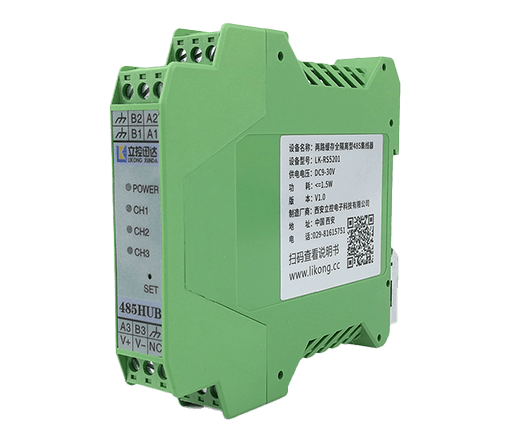
Input voltage: DC 9-30 V
Transmission distance: 1200 m
Buffer: 2048 bytes
Masters supported: 2
Data format: configurable data bits and parity
Isolation: opto-isolation on every port
Extra features: configurable master port priority
Port protection: ESD and lightning surge protection
Baud rate: 1200-115200 (set independently for every port)
The LK-RS5201 2-master fully isolated buffered RS485 hub connects two RS485 masters to one or more RS485 slaves. It queues the masters automatically and forwards their data without user intervention, eliminating the bus conflicts, data loss and errors that occur when several masters talk to the slaves at the same time.
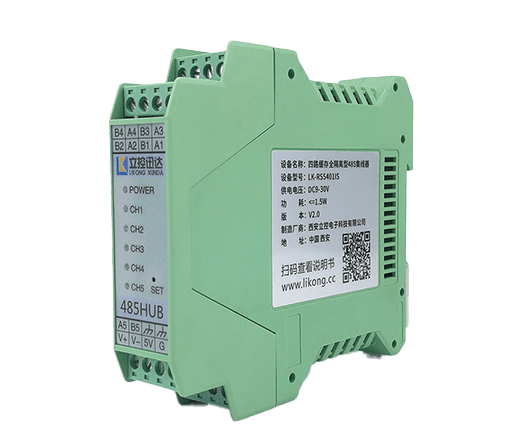
Input voltage: DC 9-30 V
Buffer: 2048 bytes
Transmission distance: 1200 m
Masters supported: 4
Isolation: opto-isolation on every port
Extra features: configurable master port priority
Port protection: ESD and lightning surge protection
Data format: configurable data bits and parity
Baud rate: 1200-115200 (set independently for every port)
The LK-RS5401 4-master fully isolated buffered RS485 hub connects four RS485 masters to one or more RS485 slaves. It queues the masters automatically and forwards their data without user intervention, eliminating the bus conflicts, data loss and errors that occur when several masters talk to the slaves at the same time.
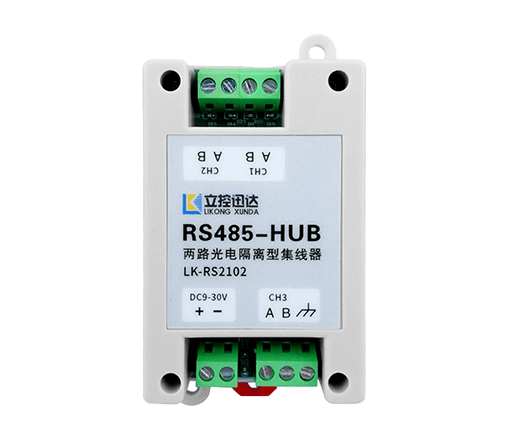
Input voltage: DC 9-30 V
Ports: 3
Transmission distance: 1200 m
Baud rate: 1200-115200, auto-detected
Isolation: opto-isolation on every port
Port protection: ESD and lightning surge protection
Data format: data bits and parity auto-detected
Nodes: up to 256 per port
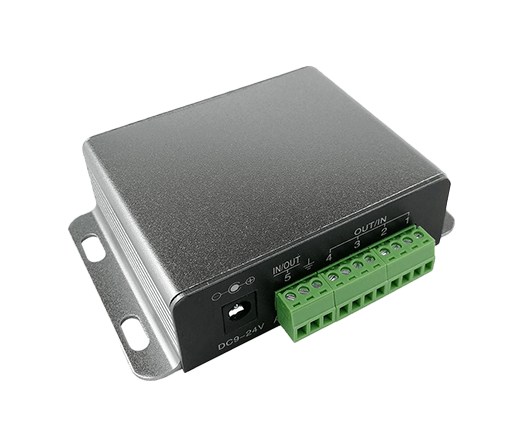
The LK-RS2102 2-port opto-isolated RS485 hub is a splitter that takes one RS485 input and provides two outputs, acting as both a signal splitter and a repeater. It solves the problems caused by irregular star wiring, adds communication ports and increases the number of slaves the bus can carry. Opto-isolation between the master and slave ports protects the master from interference, and the 15 kV ESD and 5 kA lightning surge protection devices shield the equipment from lightning and static damage. Data direction is detected in hardware, so the RS485 transmit/receive direction is switched with no delay. The power input is protected against overvoltage, overcurrent and reverse polarity, and the master and slave sides use isolated supplies. Each of the three ports has two activity LEDs, so the state of every port can be seen at a glance. Data passes transparently between master and slave ports with no restriction on baud rate, protocol or frame format - no configuration is needed, just plug and play.
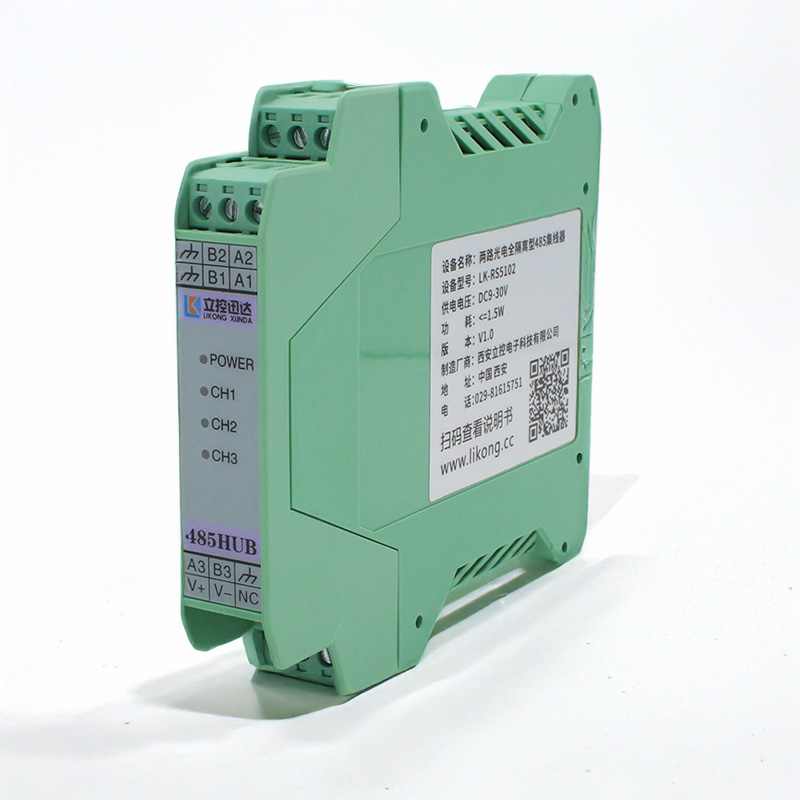
Input voltage: DC 9-30 V
Ports: 3 (1 in, 2 out)
Isolation: full opto-isolation of signal and power
Baud rate: 300-115200, auto-detected
Port protection: 15 kV ESD, 5 kA surge
Node capacity: up to 250 slaves
Applications: star wiring, signal branching, repeating
The LK-RS5102PS uses high-speed optocouplers and an isolated power supply to expand one master RS485 port transparently into two downstream networks. Data direction is detected automatically in hardware, so no protocol or baud rate needs to be set, and the unit provides signal branching, extended cable runs and multi-node isolation protection at the same time.
Input voltage: DC 9-30 V
Ports: 5
Transmission distance: 1200 m
Baud rate: 1200-115200, auto-detected
Nodes: up to 256 per port
Isolation: opto-isolation on every port
Port protection: ESD and lightning surge protection
Data format: data bits and parity auto-detected
The LK-RS2104 4-port opto-isolated RS485 hub is a splitter that takes one RS485 input and provides four outputs, acting as both a signal splitter and a repeater. It solves the problems caused by irregular star wiring, adds communication ports and increases the number of slaves the bus can carry. Opto-isolation between the master and slave ports protects the master from interference, and the 15 kV ESD and 5 kA lightning surge protection devices shield the equipment from lightning and static damage. Data direction is detected in hardware, so the RS485 transmit/receive direction is switched with no delay. The power input is protected against overvoltage, overcurrent and reverse polarity, and the master and slave sides use isolated supplies. Each of the five ports has an activity LED, so the state of every port can be seen at a glance. Data passes transparently between master and slave ports with no restriction on baud rate, protocol or frame format - no configuration is needed, just plug and play.
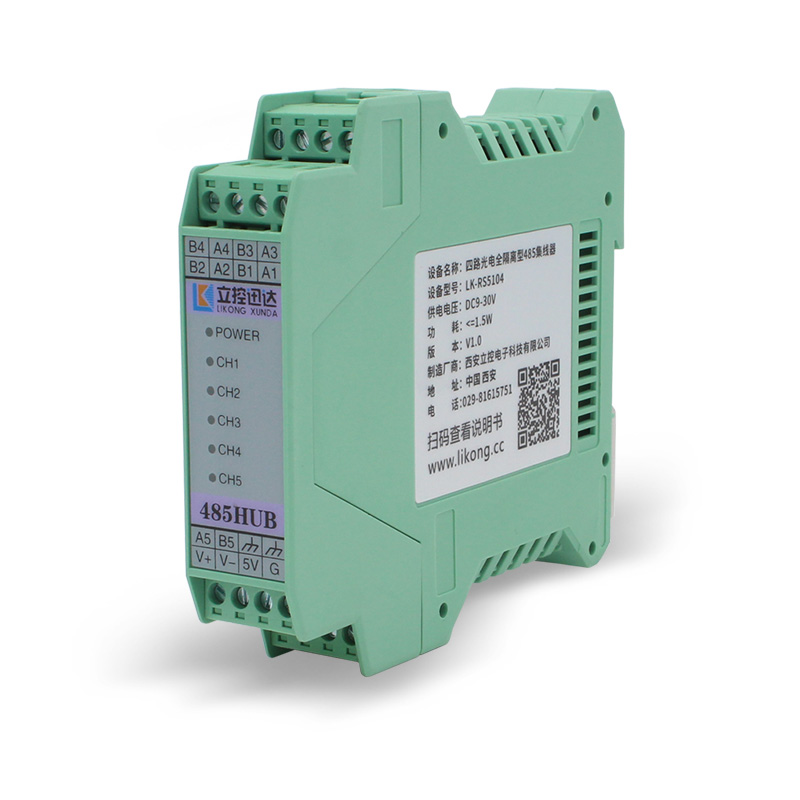
Input voltage: DC 9-30 V
Ports: 5 (1 in, 4 out)
Isolation: opto-isolation on every port
Baud rate: 300-115200, auto-detected
Port protection: 15 kV ESD, 5 kA surge
Node capacity: up to 250 slaves per channel
Applications: multi-bus expansion, star networks
The LK-RS5104PS expands a single master port into four independent downstream buses. All communication and power is fully isolated, and with surge/ESD protection and per-port activity LEDs it is well suited to adding branches in industrial automation, security and smart metering systems.
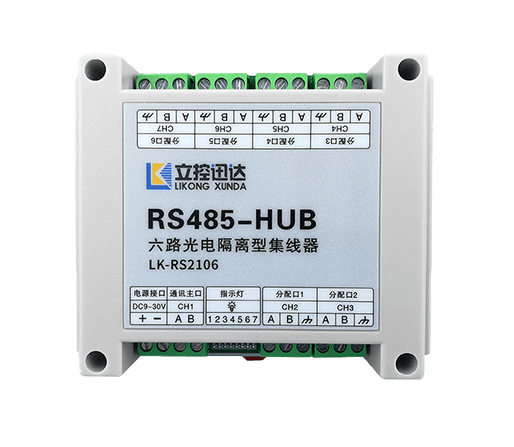
Input voltage: DC 9-30 V
Ports: 7
Transmission distance: 1200 m
Data format: data bits and parity auto-detected
Baud rate: 1200-115200, auto-detected
Nodes: up to 256 per port
Isolation: opto-isolation on every port
Port protection: ESD and lightning surge protection
The LK-RS2106 6-port opto-isolated RS485 hub is a splitter that takes one RS485 input and provides six outputs, acting as both a signal splitter and a repeater. It solves the problems caused by irregular star wiring, adds communication ports and increases the number of slaves the bus can carry. Opto-isolation between the master and slave ports protects the master from interference, and the 15 kV ESD and 5 kA lightning surge protection devices shield the equipment from lightning and static damage. Data direction is detected in hardware, so the RS485 transmit/receive direction is switched with no delay. The power input is protected against overvoltage, overcurrent and reverse polarity, and the master and slave sides use isolated supplies. Each of the seven ports has an activity LED, so the state of every port can be seen at a glance. Data passes transparently between master and slave ports with no restriction on baud rate, protocol or frame format - no configuration is needed, just plug and play.
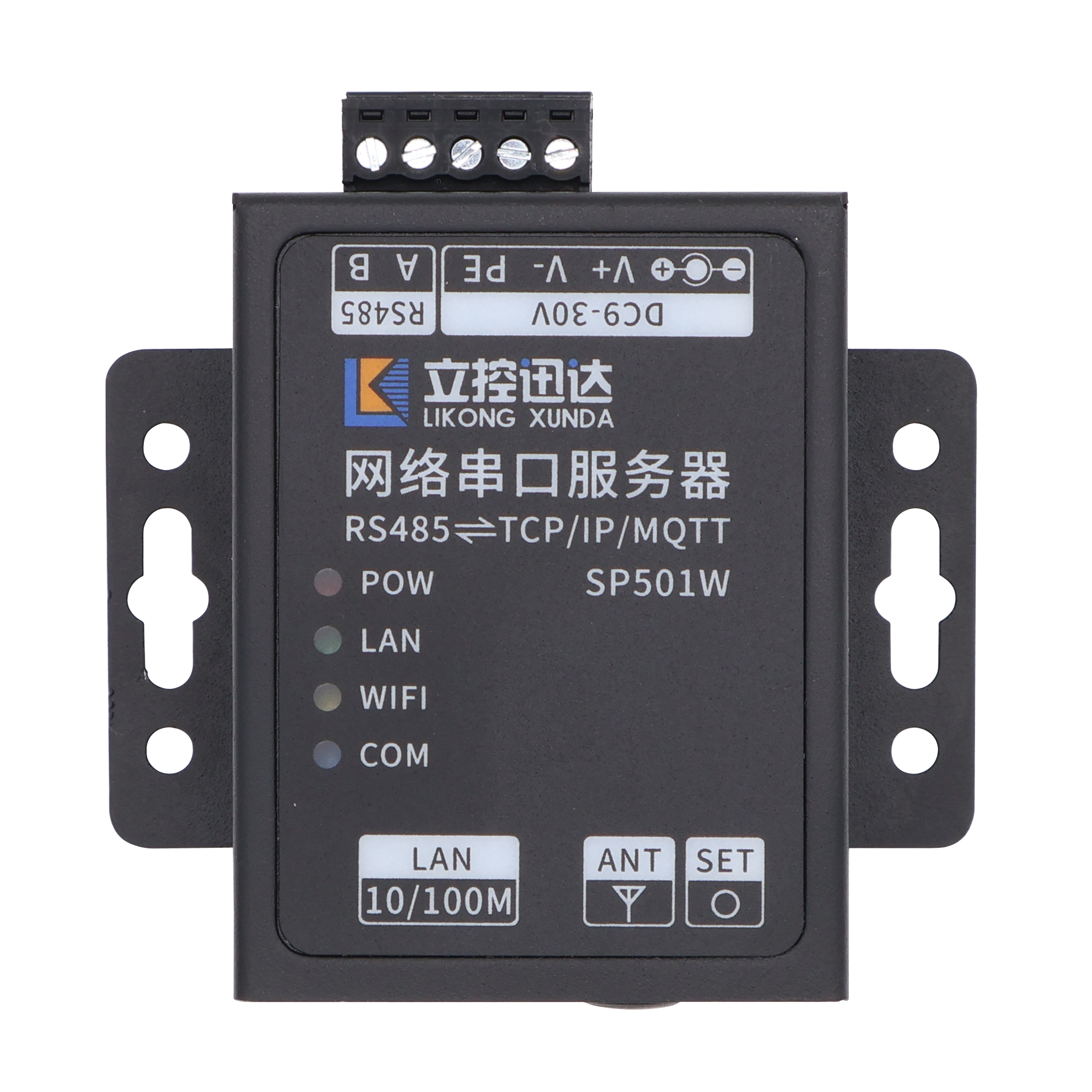
Supply voltage: DC 9-30 V / 0.5 A
Connectivity: LAN / Wi-Fi
Serial port: 1 × RS485
Baud rate: 1200-115200
Protocols: MQTT / TCP / HTTP / Modbus-TCP
Operating temperature and humidity: -40 °C to +80 °C (non-condensing)
Supports MQTT/TCP transparent transmission, Modbus-TCP to Modbus-RTU conversion and Modbus-RTU gateway mode, with a built-in web interface and virtual serial port support.
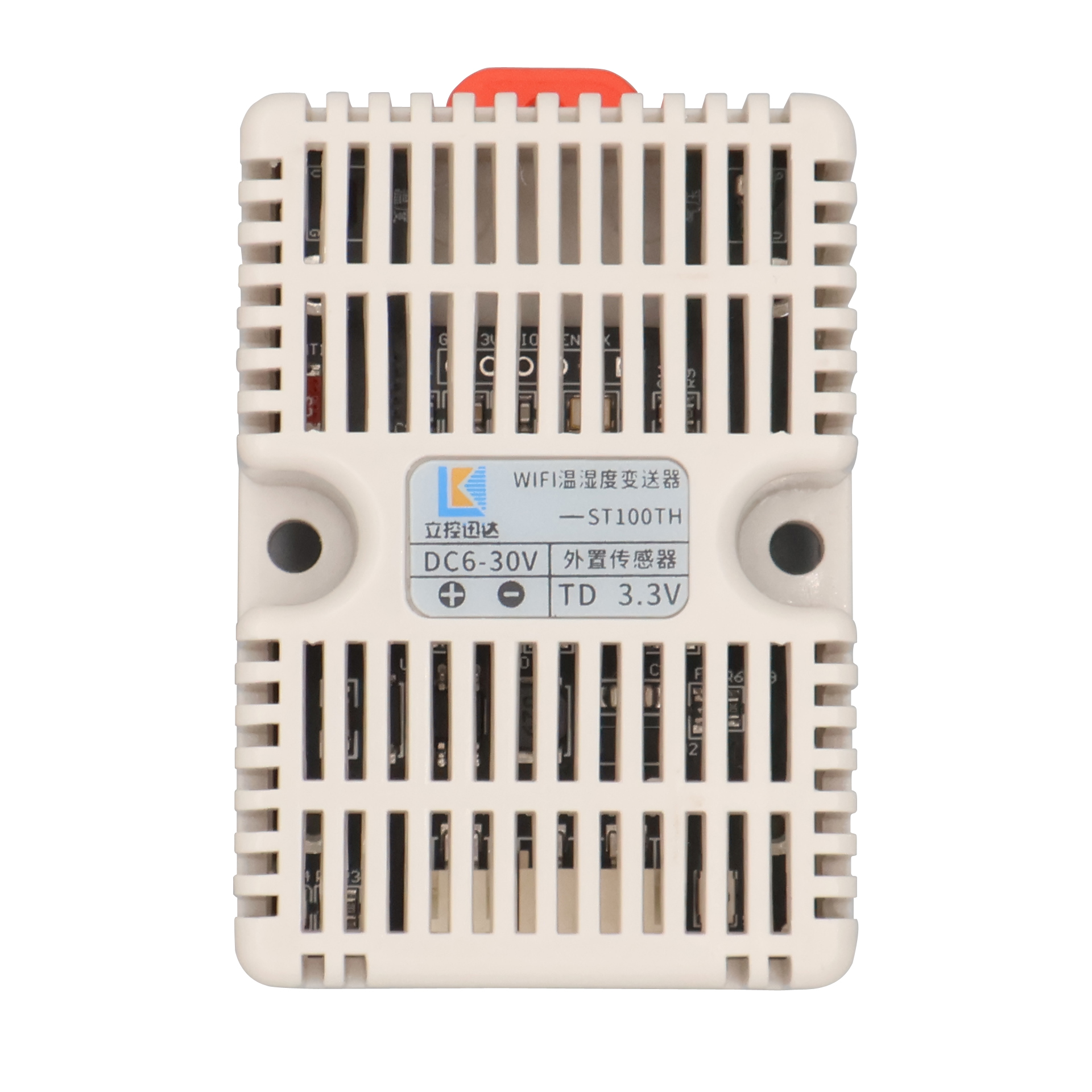
Input voltage: DC 6-30 V
Interface: Wi-Fi
Protocols: MQTT, TCP/IP, HTTP, Modbus-TCP
Measurands: temperature, humidity, barometric pressure
Sensor: built-in sensor or external probe
Configuration: built-in web interface
Firmware update: OTA supported
The ST100TH series is a Wi-Fi temperature, humidity and barometric pressure transmitter. It reports over several protocols, is configured from a built-in web page and supports OTA firmware updates, making it suitable for environmental monitoring in server rooms, warehouses, greenhouses and similar settings.
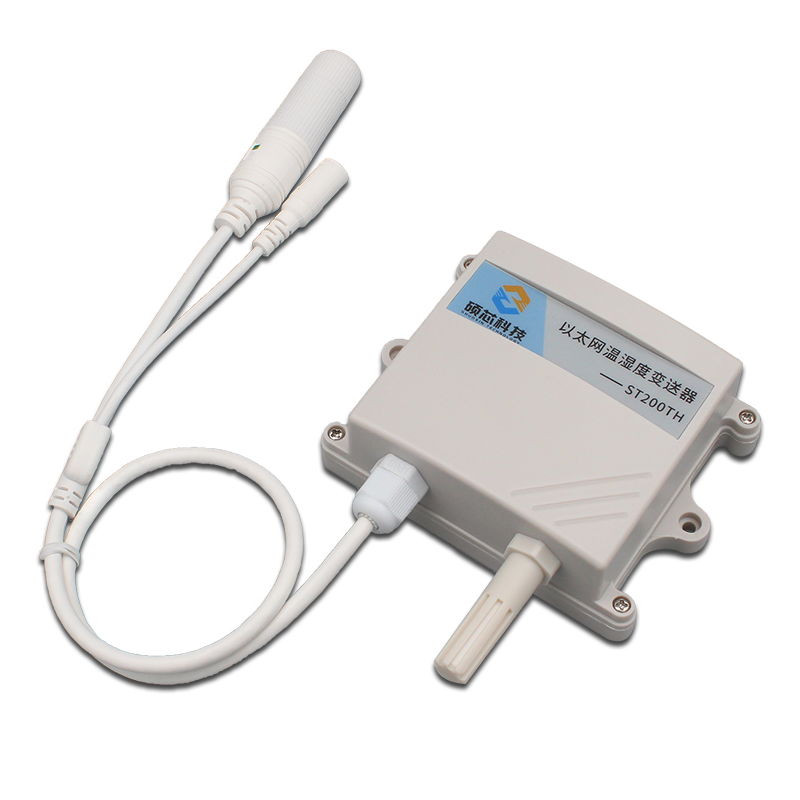
Input voltage: DC 9-30 V
Interface: wired RJ45 and Wi-Fi
Protocols: MQTT, TCP, HTTP
Measurands: temperature, humidity, barometric pressure
Power: DC or PoE
Circuit protection: overvoltage, overcurrent and reverse-polarity protection
Waterproofing: waterproof enclosure and waterproof RJ45 connector
The ST200TH series measures temperature, humidity and barometric pressure for environmental monitoring. Using an integrated or external high-accuracy digital sensor, it uploads readings over Ethernet to your own data platform or to a cloud service. It supports the common MQTT, TCP and HTTP protocols and can be powered over PoE or from an external supply. Built to industrial design standards for long-term stable operation.
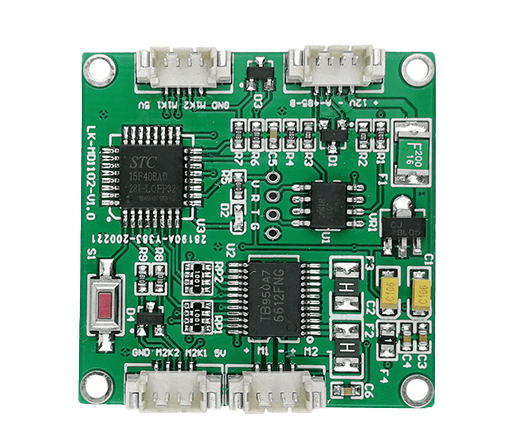
Input voltage: DC 9-15 V
Interface: RS485
Motor channels: 2
Speed control: PWM
Limit switches: 2 per channel
Drive current: 1.2 A max per channel
Protocol: Pelco-D
Motor type: brushed DC motor
The LK-MD1102 is a driver board that controls the direction and speed of two brushed DC motors. It uses H-bridge PWM speed control, giving smooth acceleration on start-up and braked stops. Limit-switch inputs stop each motor automatically when a limit is reached. The power input and motor outputs are protected against overcurrent, and the control and communication ports have ESD protection. Operating voltage is DC 9-15 V.
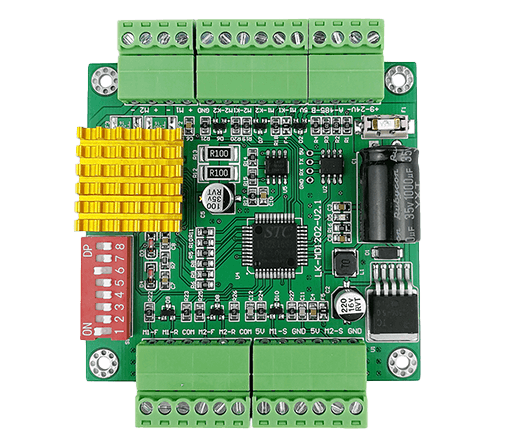
Input voltage: DC 9-24 V
Interface: RS485
Motor channels: 2
Speed control: PWM
Limit switches: 2 per channel
Drive current: 2 A max per channel
Protocol: Pelco-D
Motor type: brushed DC motor
The LK-MD1202 is a driver board that controls the direction and speed of two brushed DC motors. Two control methods are available: (1) RS485 communication using the Pelco-D protocol, and (2) local push-buttons for motor direction with a potentiometer for speed. It uses H-bridge PWM speed control, giving smooth acceleration on start-up and braked stops. Limit-switch inputs stop each motor automatically when a limit is reached. The power input and motor outputs are protected against overcurrent, and the control and communication ports have ESD protection. Operating voltage is DC 9-24 V.
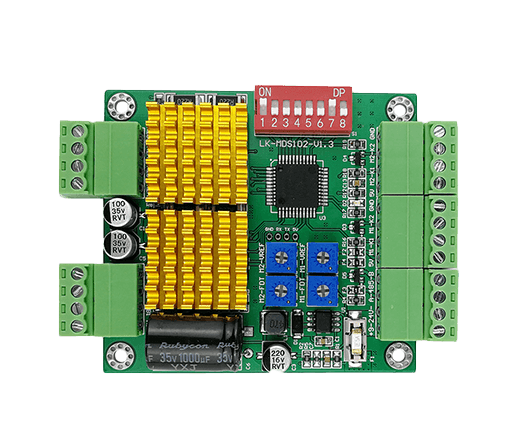
Input voltage: DC 9-24 V
Interface: RS485
Motor channels: 2
Drive current: 2 A max per channel
Protocol: Pelco-D
Microstepping: 2, 4, 8, 16 or 32, configurable
Limit switches: 2, 1 or none, configurable
Motor type: two-phase four-wire stepper motor
The LK-MD2102 is a driver board that controls the direction, speed and preset positions of two stepper motors. The driver is controlled over RS485 using the Pelco-D protocol. A dedicated stepper driver chip provides 2, 4, 8, 16 and 32 microstepping, with selectable automatic half-current hold when the motor stops. Output current is continuously adjustable from 0 to 2 A and the decay mode is configurable. Limit-switch inputs stop each motor automatically when a limit is reached. The power input and motor outputs are protected against overcurrent, and the control and communication ports have ESD protection. Operating voltage is DC 9-24 V.
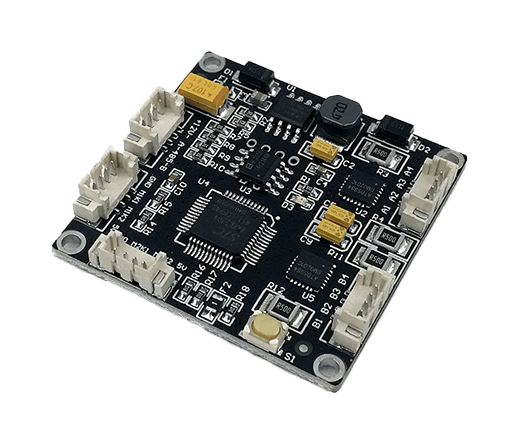
Input voltage: DC 6.5-12 V
Interface: RS485
Motor channels: 2
Speed control: PWM
Drive current: 1.2 A max per channel
Protocol: Pelco-D
Microstepping: 2, 4, 8, 16 or 32, configurable
Limit switches: 2, 1 or none, configurable
Motor type: two-phase four-wire stepper motor
The LK-MD2202 is a driver board that controls the direction, speed and preset positions of two stepper motors. The driver is controlled over RS485 using the Pelco-D protocol. A dedicated stepper driver chip provides 2, 4, 8 and 16 microstepping, with selectable holding current when the motor stops, and an output current adjustable from 0.1 to 1.2 A. Limit-switch inputs stop each motor automatically when a limit is reached. The power input and motor outputs are protected against overcurrent, and the control and communication ports have ESD protection. Operating voltage is DC 6.5-12 V.
Input voltage: DC 12 V
Interface: RS485
Relay outputs: 4
Digital inputs: 6
Protocol: Modbus-RTU
Baud rate: 2400-19200, configurable
Wireless remote: optional 433 MHz remote control
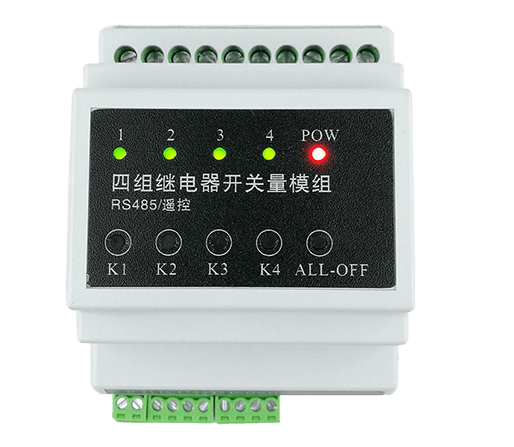
The LK-RM304 is an RS485 board with four high-power relay outputs and six digital inputs. Modbus control software, an HMI, a PLC or similar equipment can switch the relays and read back both the relay states and the digital inputs. It supports 315 MHz / 433 MHz remote controls, and the enclosed version can also be operated from local push-buttons. Suitable for IoT and automation control applications.
Input voltage: DC 12 V
Interface: RS485
Relay outputs: 10
Digital inputs: 10
Protocol: Modbus-RTU
Baud rate: 2400-19200, configurable
Wireless remote: optional 433 MHz remote control
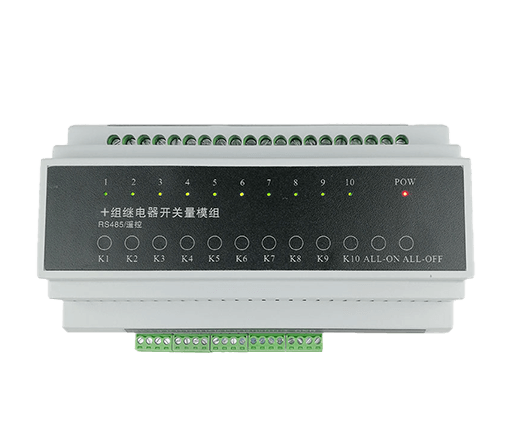
The LK-RM310 is an RS485 board with ten high-power relay outputs and ten digital inputs. Modbus control software, an HMI, a PLC or similar equipment can switch the relays and read back both the relay states and the digital inputs. It supports 315 MHz / 433 MHz remote controls, and the enclosed version can also be operated from local push-buttons. Suitable for IoT and automation control applications.
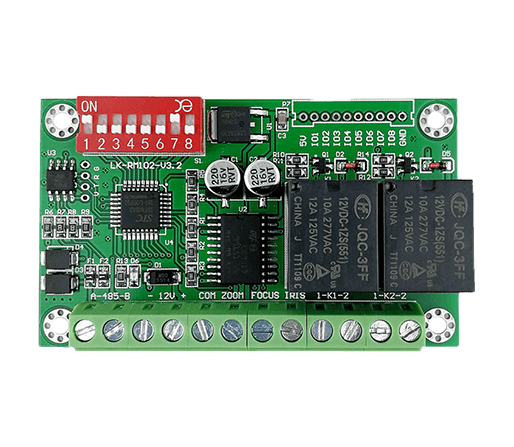
Input voltage: DC 12 V
Interface: RS485
Protocol: Pelco-D
Baud rate: 2400-19200, configurable
Relay outputs: 2 (light, wiper)
Voltage outputs: 3 (zoom, focus, iris)
The LK-RM102L is a controller for two- or three-motor powered lenses, using RS485 with the Pelco-D/P protocol. It provides three reversible DC voltage outputs for lens zoom, focus and iris - these can equally drive three DC motors - plus two relay outputs for accessories such as wipers and lights. Eight on-board digital inputs allow push-buttons to operate the relays and voltage outputs directly.
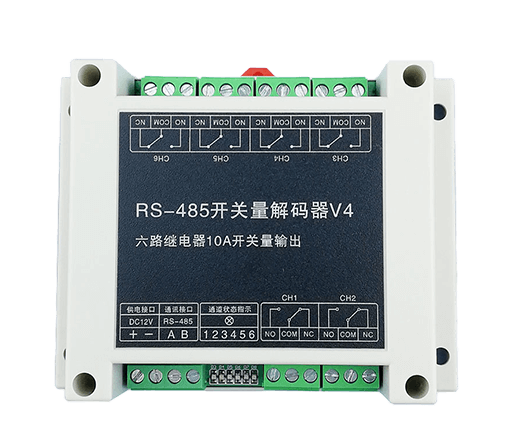
Input voltage: DC 12 V
Interface: RS485
Protocol: Pelco-D
Baud rate: 2400-19200, configurable
Relay outputs: 6
Wireless remote: optional 433 MHz remote control
The LK-RM206 is an RS485 board with six high-power relay outputs. Any device that speaks the Pelco-D protocol can switch the relays, making it suitable for switching power, communication lines or other control lines. Typical applications include lighting, barriers, powered gates and DC motors.
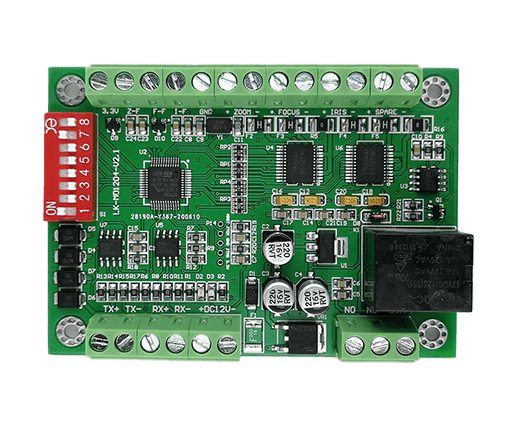
Input voltage: DC 12 V
Interface: RS485
Protocol: Pelco-D
Relay outputs: 1
ADC resolution: 12-bit
Preset positions: 200
Baud rate: 2400-19200, configurable
Lens control: zoom, focus, iris, defog
The LK-MD1204 drives two- or three-motor powered lenses, controlling zoom, focus, iris, defog and 2x extender functions. When lens feedback signals are connected, it supports preset positions for zoom, focus and iris, and it can equally drive four independent DC motors. RS485 and RS422 are both selectable; the Pelco-D protocol can be used to read back zoom, focus and iris positions or command the lens to a specific position.
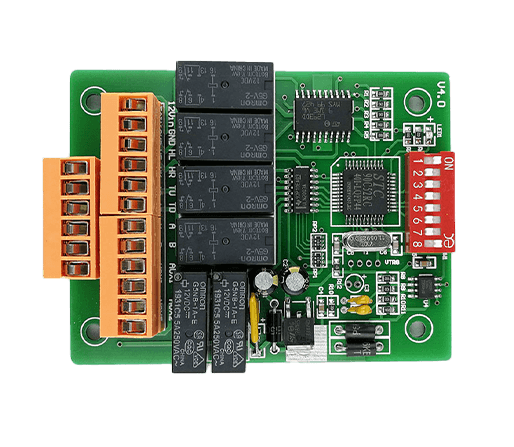
Input voltage: DC 12 V
Interface: RS485
Protocol: Pelco-D
Relay outputs: 2
PTZ control: pan and tilt
Motor type: brushed DC motor
Baud rate: 2400-19200, configurable
Lens control: zoom, focus, iris
The LK-PT1102 drives up to four brushed DC motors, with forward and reverse control on each one.
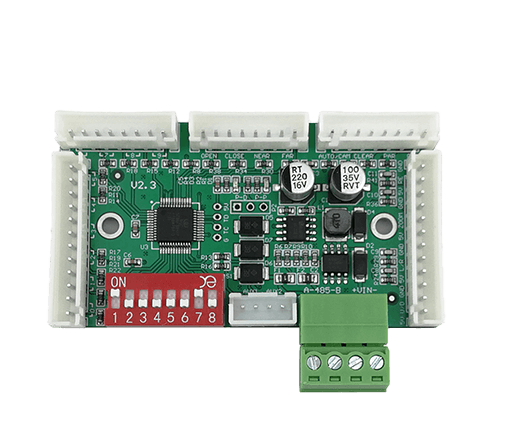
Input voltage: DC 12 V
Interface: RS485
Analogue inputs: 4
Control: joystick or push-buttons
Lens control: zoom, focus, iris
PTZ control: pan and tilt
Baud rate: 2400-19200, configurable
Protocol: Pelco-D or proprietary protocol
The LK-CK100 converts switch and voltage signals into digital data and sends it over RS485. It can drive Pelco-D/Pelco-P PTZ heads and dome cameras - pan and tilt movement plus camera focus, zoom, iris, presets, lights and wipers - and it can equally be used to read digital and analogue voltage signals over RS485. Address and baud rate are set with DIP switches; joystick type and protocol are set from the PC software.